Saturday, April 09, 2011

3. Alternatives to Driving


Livable communities with better transportation choices including transit and opportunities for bicycling and walking reduce the need to drive.


Los Angeles' Measure R and "30/10" – now "America Fast Forward" – will expand our transit network, including the Wilshire subway to Westwood (above).

Grid-connected electric transit – streetcars, light and heavy rail, and electric trolleybuses are quiet, energy-efficient, and proven. As Gilbert and Perl note, "Electricity is the ideal transport fuel for an uncertain future. Unlike other alternative energy transition paths for transport, only electric mobility can move people and goods using a wide range of energy sources."
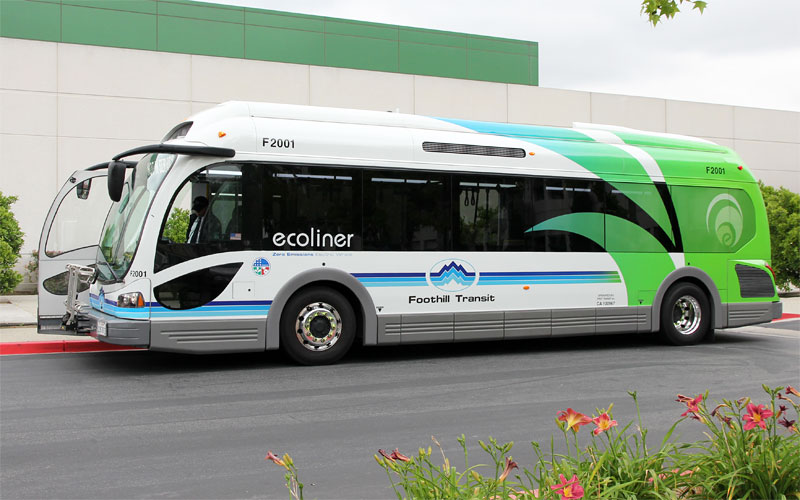

New battery electric buses being tested on Foothill Transit may provide a good alternative to diesel and natural gas powered transit buses (Proterra photo; also MetroRiderLA). See George Karbowski's SCAQMD presentation (3 MB PDF) for technical details.


"Complete Streets" make communities more livable with inviting places to walk and bike, instead of driving (Charles Gandy, City of Long Beach image).


Urban parks importantly balance higher-density residential.


Ridesharing (via smart-phone apps) may be the fastest adjustment for an oil shock.


Intercity high speed rail will replace oil used by long-distance driving and intrastate plane flights (CHSRA image).


Moving freight to rail is much more efficient than trucks, and railroads can be electrified to become entirely oil-free.

NEXT: 4. Electric Vehicles BACK: 2. Global Warming

Friday, April 08, 2011

4. Electric Vehicles


Plug-in electric vehicles, now beginning to be available (such as the battery-electric Nissan Leaf, above, and plug-in hybrid Chevy Volt), are the most feasible alternative to oil-powered cars.


Vehicle fuel efficiency helps, but cannot get us off oil. EPA-NHTSA rulemaking – in conjunction with California ARB – is beginning for 2017-2025. A range of 3-6% annual improvement would result in 47-62 mpg in 2025, compared with 34.1 mpg in 2016 and 27.5 mpg of the old (1990-2010) CAFE.

In comparison, a 2004-9 Toyota Prius midsize car was rated at 46 mpg. A fleet averaging that would cut U.S. gasoline use in half and U.S. oil use by 1/4.

Cartoon (c) by Steve Nease, used with permission


Most U.S. personal trips are by car (U.S. Census, SF-3, QT-P23), although less so in dense cities with good public transit like San Francisco, where only 41% drove alone, 31% rode transit, and 9% walked – a strong reason to oppose new sprawl development.


Fifty percent of drivers travel less than 25 miles per day (EPRI PDF). There is ample off-peak grid capacity today for overnight charging, and vehicle batteries can become distributed storage for demand peaks and renewable supply.


From renewable solar, wind, and geothermal power, the core of our clean energy, green jobs economic future.


But even on U.S. average-mix electricity Argonne National Lab's June 2010 "Well-to-Wheels Analysis ..." documented that plug-ins have lower GHG emissions than equivalent ICE gasoline cars, about the same on a coal-intensive mix, and of course much better with renewables (Figure ES-1, page 3).

See also Michael Brune's Sierra Club blogs 10/6/10 and 3/10/11; California ARB on zero Emission Vehicles, advocate Plug In America, Top 11 Electric Car Myths, and lithium availability.


We will need to plan for charging stations in apartment garages, public street parkways, and retail and commercial locations.


Biofuels, conversely, fail the key criteria of scalability, net energy, and external impacts.

Ethanol from corn uses about as much fossil-fuel energy to grow and make as it yields. It consumes water and fertilizer and competes with food production. Ethanol from sugar cane in Brazil is more sustainable, but not scalable to replace any large portion of oil.

Cellulosic ethanol is not in large-scale production, and has poor net energy due to transporting biomass and distilling the alcohol.

Biodiesel from used french fry oil sounds great, but there's not very much used french fry oil! The most productive oil crops are palm oil and soybeans. Their expanded production threatens rainforest land, hardly a benefit to global warming emissions.

See also Robert Rapier on The Palm Oil Conundrum and Five Challenges of Next-Generation Biofuels.


Hydrogen is an energy carrier, not source. It is mostly created from natural gas today, just another fossil fuel.

Even if electrolyzed from renewable electricity, it is less efficient to make, compress, and run a fuel cell on hydrogen than to just charge a battery (page 5, Table 2 in Boschert).

We need a solution now, but fuel cell vehicles are extremely expensive, plus there is no hydrogen fueling infrastructure.

BACK: 3. Alternatives to Driving

Monday, May 03, 2010

Move LA, part 1


This is a web version of my presentation at Move LA's Transportation Conversation II, an environmental perspective on Los Angeles transportation.

The starting point always is our awful traffic.


Second are the impacts of our oil dependence. The U.S. imports 2/3 of what we use. U.S. production peaked in 1970 - despite all the new production in Alaska - and world production's high point was 2005 (US EIA data).


If one imagined what a divine message might be on the eve of Senate debate about national energy policy, it's hard to imagine a bigger one than the gulf oil catastrophe right now (US Coast Guard photo).


Third is Global Warming, documented here by continuing rise in world temperatures (NASA chart).

(Click any image to enlarge)


Transportation and electricity generation are over half the total greenhouse gas emissions (CARB AB 32 Scoping Plan data).


California's AB 32 goal is to reduce emissions to 1990 levels by 2020 and 80% by 2050 (more on AB 32 Scoping Plan).


The first solution is simple efficiency: if every car got the mileage of today's Prius, the U.S. would use half as much gasoline, one fourth less oil, as vividly illustrated in this cartoon by Steve Nease (used with permission).


The most cost-effective and scalable sources of renewable energy are wind ...


... and solar.


So sustainable transportation must transition to electricity. Measure R funding includes extending the electric Wilshire subway ...

(continue to part 2)

Move LA, part 2


(continued from part 1)

... and expanding L.A.'s light rail network.


We seek cities' use of local return funds for bicycle and pedestrian improvements, as the City of Los Angeles just approved 10% for.


This map from The Transit Coalition suggests a number of rail corridors beyond the Measure R map. I'd highlight (1) extending the Crenshaw line from the Expo line up to Hollywood and (2) north south corridors from Westwood to LAX along Lincoln and/or the 405.


California High Speed Rail is important to Los Angeles, that will replace many intra-state plane flights and long car drives with electric trains (earlier post on Prop. 1A; California High Speed Rail Blog).


A few cities like San Francisco still have electric trolley buses.


The new company Proterra will be testing battery-electric buses that fast-charge at the end of their routes on Foothill Transit this year.


Plug-in hybrid and battery-electric vehicles are very important for all the trips that do not fit biking, walking, or transit. The first two major auto company models are the Chevy Volt and Nissan Leaf, due late this year (EVs and Energy Blog; Plug In America).


Finally, a major benefit of rail transit is enabling effective Transit Oriented Development within walking distance of stations, like here at Del Mar in Pasadena on the Gold Line. But will it live up to Smart Growth or just be auto-oriented "dumb density"?


Livable streets that encourage walking to neighborhood shops are very important. These two examples from Portland's Pearl District show the kind of amenities that make you feel at home.


Parks and open space for kids and older people are very important to balance increased density.