Saturday, April 09, 2011

2. Global Warming


A strong, credible body of scientific evidence shows that climate change is occurring, is caused largely by human activities, and poses significant risks for a broad range of human and natural systems. – U.S. National Academy of Sciences, 2010
This January 2011 NASA chart shows 2010 tied (with 2005) for the hottest year on record, and is part of the hottest decade on record. It "is compiled from weather data from more than 1000 meteorological stations around the world, satellite observations of sea surface temperature and Antarctic research station measurements."


Multiple reconstructions of historic temperatures show it is now the hottest in 2,000 years (PDF). More perspective on temperature reconstructions from Climate Progress and Skeptical Science.


Glaciers and ice sheets are melting around the world. For example, Muir Glacier in Alaska's Glacier Bay National Park, 1892 (left), has vanished in 2005 (right; both USGS).

Arctic sea ice is at record lows, and melting of the Greenland and Antarctic ice sheets is increasing. The “Albedo Effect” of shiny ice replaced by dark ocean further accelerates warming.


Not only is sea level rising, but most of the excess heat and has been absorbed in the ocean, resulting in stronger hurricanes. CO2 is also making the ocean more acidic, endangering shellfish and coral reefs.

A new NASA-Jet Propulsion Laboratory study projects a one-foot rise by 2050. If the 100,000-year-old, mile-thick Greenland Ice Sheet melted it would raise sea level over 23 feet.


Effects of global warming include extreme weather – severe heat, storms, floods, drought and dust bowls. Great wildfires (photo – Station Fire behind downtown Los Angeles, August 2009) are a result of heat, drought, and pine borer beetles that were formerly killed by cold winters.


Greater heat and less water reduce food crops.


Climate doesn't change all by itself for no good reason. Something has to force it. – Mark Serreze, National Snow and Ice Data Center director

The Greenhouse Effect is well-documented. That something is CO2 levels, primarily from burning fossil fuels over the last century – and other greenhouse gases – that have risen with temperature (NASA chart). This atmospheric CO2 acts like a thermostat to control the temperature of the Earth.


Warming is not caused by the sun: temperature is rising despite falling solar irradiance.

In fact, 97% of climate experts agree humans are causing global warming via greenhouse gas emissions.

See more in NASA's Climate change: How do we know?, Empirical evidence that humans are causing global warming, and Climate Progress, especially:


Transportation is the second-largest emissions sector nationally (above, US EPA, Tables 2-12 & 2-15) and the greatest in California (due to less coal-fired electricity, below, CARB; more on AB 32 Scoping Plan)

NEXT: 3. Alternatives to Driving BACK: 1. Oil Supply

3. Alternatives to Driving


Livable communities with better transportation choices including transit and opportunities for bicycling and walking reduce the need to drive.


Los Angeles' Measure R and "30/10" – now "America Fast Forward" – will expand our transit network, including the Wilshire subway to Westwood (above).

Grid-connected electric transit – streetcars, light and heavy rail, and electric trolleybuses are quiet, energy-efficient, and proven. As Gilbert and Perl note, "Electricity is the ideal transport fuel for an uncertain future. Unlike other alternative energy transition paths for transport, only electric mobility can move people and goods using a wide range of energy sources."


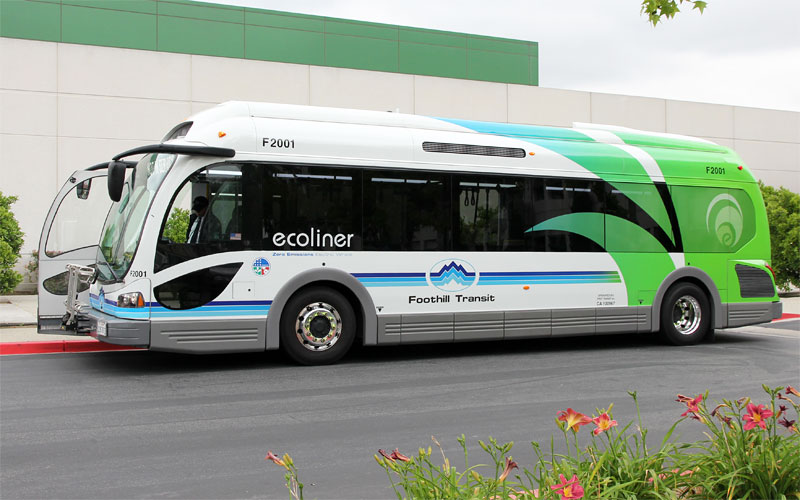
New battery electric buses being tested on Foothill Transit may provide a good alternative to diesel and natural gas powered transit buses (Proterra photo; also MetroRiderLA). See George Karbowski's SCAQMD presentation (3 MB PDF) for technical details.


"Complete Streets" make communities more livable with inviting places to walk and bike, instead of driving (Charles Gandy, City of Long Beach image).


Urban parks importantly balance higher-density residential.


Ridesharing (via smart-phone apps) may be the fastest adjustment for an oil shock.


Intercity high speed rail will replace oil used by long-distance driving and intrastate plane flights (CHSRA image).


Moving freight to rail is much more efficient than trucks, and railroads can be electrified to become entirely oil-free.

NEXT: 4. Electric Vehicles BACK: 2. Global Warming

Friday, April 08, 2011

4. Electric Vehicles


Plug-in electric vehicles, now beginning to be available (such as the battery-electric Nissan Leaf, above, and plug-in hybrid Chevy Volt), are the most feasible alternative to oil-powered cars.


Vehicle fuel efficiency helps, but cannot get us off oil. EPA-NHTSA rulemaking – in conjunction with California ARB – is beginning for 2017-2025. A range of 3-6% annual improvement would result in 47-62 mpg in 2025, compared with 34.1 mpg in 2016 and 27.5 mpg of the old (1990-2010) CAFE.

In comparison, a 2004-9 Toyota Prius midsize car was rated at 46 mpg. A fleet averaging that would cut U.S. gasoline use in half and U.S. oil use by 1/4.

Cartoon (c) by Steve Nease, used with permission


Most U.S. personal trips are by car (U.S. Census, SF-3, QT-P23), although less so in dense cities with good public transit like San Francisco, where only 41% drove alone, 31% rode transit, and 9% walked – a strong reason to oppose new sprawl development.


Fifty percent of drivers travel less than 25 miles per day (EPRI PDF). There is ample off-peak grid capacity today for overnight charging, and vehicle batteries can become distributed storage for demand peaks and renewable supply.


From renewable solar, wind, and geothermal power, the core of our clean energy, green jobs economic future.


But even on U.S. average-mix electricity Argonne National Lab's June 2010 "Well-to-Wheels Analysis ..." documented that plug-ins have lower GHG emissions than equivalent ICE gasoline cars, about the same on a coal-intensive mix, and of course much better with renewables (Figure ES-1, page 3).

See also Michael Brune's Sierra Club blogs 10/6/10 and 3/10/11; California ARB on zero Emission Vehicles, advocate Plug In America, Top 11 Electric Car Myths, and lithium availability.


We will need to plan for charging stations in apartment garages, public street parkways, and retail and commercial locations.


Biofuels, conversely, fail the key criteria of scalability, net energy, and external impacts.

Ethanol from corn uses about as much fossil-fuel energy to grow and make as it yields. It consumes water and fertilizer and competes with food production. Ethanol from sugar cane in Brazil is more sustainable, but not scalable to replace any large portion of oil.

Cellulosic ethanol is not in large-scale production, and has poor net energy due to transporting biomass and distilling the alcohol.

Biodiesel from used french fry oil sounds great, but there's not very much used french fry oil! The most productive oil crops are palm oil and soybeans. Their expanded production threatens rainforest land, hardly a benefit to global warming emissions.

See also Robert Rapier on The Palm Oil Conundrum and Five Challenges of Next-Generation Biofuels.


Hydrogen is an energy carrier, not source. It is mostly created from natural gas today, just another fossil fuel.

Even if electrolyzed from renewable electricity, it is less efficient to make, compress, and run a fuel cell on hydrogen than to just charge a battery (page 5, Table 2 in Boschert).

We need a solution now, but fuel cell vehicles are extremely expensive, plus there is no hydrogen fueling infrastructure.

BACK: 3. Alternatives to Driving

Monday, May 03, 2010

Move LA, part 1


This is a web version of my presentation at Move LA's Transportation Conversation II, an environmental perspective on Los Angeles transportation.

The starting point always is our awful traffic.


Second are the impacts of our oil dependence. The U.S. imports 2/3 of what we use. U.S. production peaked in 1970 - despite all the new production in Alaska - and world production's high point was 2005 (US EIA data).


If one imagined what a divine message might be on the eve of Senate debate about national energy policy, it's hard to imagine a bigger one than the gulf oil catastrophe right now (US Coast Guard photo).


Third is Global Warming, documented here by continuing rise in world temperatures (NASA chart).

(Click any image to enlarge)


Transportation and electricity generation are over half the total greenhouse gas emissions (CARB AB 32 Scoping Plan data).


California's AB 32 goal is to reduce emissions to 1990 levels by 2020 and 80% by 2050 (more on AB 32 Scoping Plan).


The first solution is simple efficiency: if every car got the mileage of today's Prius, the U.S. would use half as much gasoline, one fourth less oil, as vividly illustrated in this cartoon by Steve Nease (used with permission).


The most cost-effective and scalable sources of renewable energy are wind ...


... and solar.


So sustainable transportation must transition to electricity. Measure R funding includes extending the electric Wilshire subway ...

(continue to part 2)